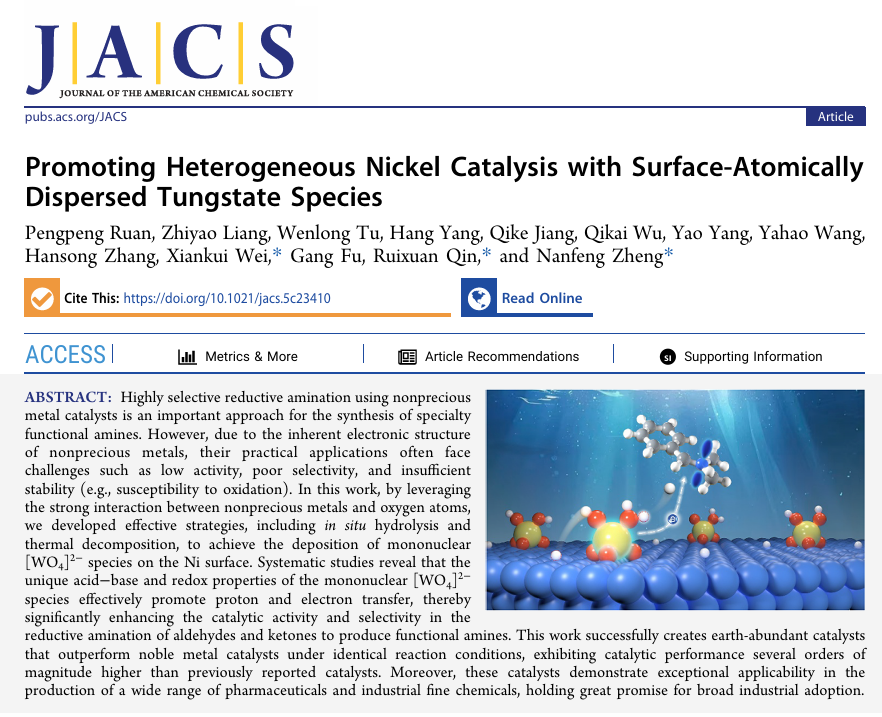
Recently, Professor Wei Xiankui from our group, in collaboration with Professors Zheng Nanfeng and Qin Ruixuan, made an important breakthrough in the research on the selective reduction amidation of aldehydes/ketones using non-precious metal catalysts. The related results were published in J. Am. Chem. Soc. under the title "Promoting Heterogeneous Nickel Catalysis with Surface Atomically Dispersed Tungstate Species".
Realizing high selectivity in the amidation reaction using non-precious metal catalysts is an important technical path for the synthesis of functional amine compounds. However, such catalysts have long faced problems such as poor activity, poor selectivity, and poor stability. The research team, leveraging the strong interaction between transition metal nickel and oxygen atoms, developed an in-situ hydrolysis and thermal decomposition strategy, successfully precisely constructing monodisperse [WO4]2- species on the nickel-based surface. This species can effectively inhibit side reactions, enhance the oxidation resistance of nickel, and significantly improve the catalytic activity and selectivity. The catalytic activity is far superior to that of the reported non-precious metal catalytic systems, demonstrating broad industrial application prospects.
This research took seven years to complete. Associate Researcher Ruan Pengpeng from the Jia Gong Innovation Laboratory was the first author of the paper. Our group's 2023 doctoral student Liang Zhiyao and the research team of Professor Yang Yao from Westlake University assisted in completing the aberration-corrected electron microscopy test, providing key microscopic characterization data for the research.
Mobile browsing
No public